
What really shapes traditions in Spain? They come from hundreds of years of history, strong regional identity, and a clear love of community life, celebrations, and family. These traditions are much more than simple habits. They are a big part of what keeps Spanish communities together. You can see them in quiet religious processions and also in loud local fiestas. Many of these customs feel personal, but they are also shared by whole towns and cities, which makes them easy for visitors to join and understand.
What Defines Traditions in Spain?
Spanish traditions mix old and new ideas. They change over time, but they still keep a link to the past. Many traditions include the public, strong sights and sounds, and lots of social contact. This can be sharing tapas, taking a late walk with family, or watching fireworks with a crowd. In Spain, people often prefer being together and talking over spending time alone.
What Are the Historical Roots of Spanish Traditions?
The roots of Spanish traditions go back a very long time, and many groups have left their mark on the Iberian Peninsula. Before the Romans, local Iberian peoples created early cultural bases. The Roman Empire later brought Latin, laws, and city planning, which influenced language, buildings, and daily life. After Rome, the Visigoths helped spread Christianity across the peninsula.
One of the biggest influences came after the Moorish conquest in the 8th century. For almost 800 years, Islamic culture grew in al-Andalus, bringing new farming methods, science, building styles, and art that strongly shaped southern Spain and other areas. The long period of living side by side (and also fighting) between Christian and Muslim groups, ending with the Reconquista, helped form Spain’s cultural identity. Later, the Catholic Monarchs made Catholicism the main religion, placing it deeply into public life and creating many of the religious festivals and practices still seen today.
How Do Regional Differences Influence Traditions in Spain?
Spain is often called a “nation of nations,” and this is clear in its traditions. Customs can be very different from one region to another. Even though many areas share the same passion and focus on community, each autonomous community has its own traditions, languages, and styles. For example, the Basque Country (Euskadi) has strong independence and its own language, which connects to traditions like rural sports and food societies. These feel very different from the flamenco and bullfighting image often linked to Andalusia.
Catalonia also has its own language and strong identity. It celebrates traditions like Castells (human towers) and the Sardana dance, both centered on teamwork. In the northwest, Galicia has Celtic roots that appear in its music and stories, and it is linked to the Camino de Santiago pilgrimage. These differences are not small details; they show local pride and local history, making Spain feel like a cultural mosaic.

Which Values Are Reflected in Spanish Customs?
Spanish customs reflect values that guide daily life. Family (la familia) matters deeply, and it often includes grandparents, aunts, uncles, and cousins who stay involved with each other. This creates strong loyalty and support, especially during gatherings and celebrations.
Community is another key value. You can see it in local festivals, neighborhood groups, and the way people spend time in plazas and streets. Celebration and enjoyment (fiesta) are also central, with life events and religious holidays marked by music, food, and shared time. Passion shows up in art, dance, and even regular conversation. Many people also show respect for older family members and keep a relaxed attitude to time, choosing people and relationships over strict schedules.
Religious and Spiritual Traditions
Religion, especially Catholicism, has long been a major part of Spanish identity and culture. Spain today is more secular than before, but religious traditions are still strong, from serious processions to happy saint-day celebrations.
Role of Catholicism in Spanish Traditions
Catholicism in Spain is more than a private belief; it has shaped public culture for centuries. You can see it in cathedrals and small churches, in place names, and in the yearly festival calendar. Catholic life events-baptisms, first communions, weddings, and funerals-still mark important moments for many people, even if they do not go to church often.
Devotion to saints and the Virgin Mary is common, and many towns have a patron saint. That saint’s day is often celebrated with strong local pride. Because of this, the symbols and ceremonies of Catholicism remain a visible part of Spanish culture, and many people join in for cultural reasons as well as religious ones.
Pilgrimages and Saint Festivities
Pilgrimages are an important part of spiritual life in Spain, and the Camino de Santiago is the best-known example. This network of routes leads to the Cathedral of Santiago de Compostela in Galicia, where St. James is believed to be buried. Each year, hundreds of thousands of people walk the Camino. Many do it for faith, personal reflection, or the experience of meeting others along the way.
Alongside the Camino, many towns celebrate patron saint festivals (fiestas patronales). These often include a procession, mass, music, dancing, traditional foods, and fireworks. They bring whole communities together and help keep local identity strong across generations.
Festival of Souls and Local Spiritual Events
All Saints’ Day (Día de Todos los Santos) on November 1st is an important spiritual date across Spain. Families remember loved ones who have died by visiting cemeteries, cleaning graves, bringing flowers, and lighting candles. The mood is quiet and reflective, and it highlights the ongoing bond between the living and the dead.
Many regions also have smaller local spiritual events. Some are connected to farming seasons or old local stories. These may include blessing animals or local pilgrimages (romerías) to countryside shrines. Often, people mix religious devotion with a day out together, with food and social time.
How Daily Life Reflects Spanish Traditions
Traditions in Spain are not limited to big festivals. They also appear in everyday routines, like meal times and social habits. These customs create a daily rhythm that feels very Spanish.
Organization of the Spanish Day: Meals, Siesta, and Schedules
The daily schedule in Spain often surprises visitors because meals happen late. Lunch (la comida), the main meal, is usually between 2:00 PM and 3:00 PM and can last an hour or more. Dinner (la cena) often starts at 9:00 PM or later, especially in summer. This means work and social life can continue well into the evening.
The siesta is not something everyone does every day now, especially in big cities, but the mid-afternoon break still matters. In many smaller towns, shops may close for a couple of hours. People use this time for a long lunch, a break from the heat, and sometimes a short rest. It shows a cultural preference for balancing work with personal life and social time.
The Art of Sobremesa: Socializing After Meals
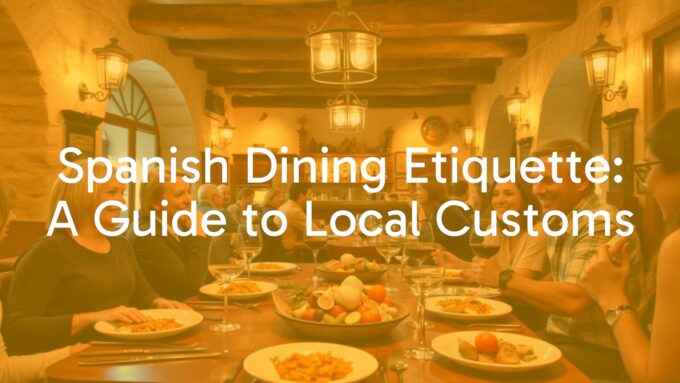
One of the most loved Spanish customs is sobremesa, the time spent talking after a meal. It means staying at the table to relax, laugh, and connect. After the plates are cleared, coffee is served, and people often keep talking without rushing.
During sobremesa, conversations can be light or serious. People share stories, discuss ideas, and simply enjoy being together. This reflects how much Spanish culture values shared time, and it helps strengthen relationships.

Traditional Spanish Etiquette: Greetings, Two Kisses, and Gestures
Spanish etiquette is friendly and expressive, often less formal than in some other European countries. In many social settings, women commonly greet with two kisses (dos besos), one on each cheek, starting with the right. Men often shake hands, and close friends may hug.
People usually stand closer while talking than in many English-speaking cultures, and casual touch is more common. Hand gestures are also a normal part of conversation and help show feeling and emphasis. Eye contact is usually steady, showing interest and honesty. Knowing these habits can help you feel more comfortable in Spanish social life.
Traditional Spanish Food and Drink Customs
In Spain, food is not just fuel. It is a key part of social life, celebrations, and regional identity. Food traditions appear in daily routines and in holiday events, showing a culture that enjoys eating and drinking slowly and together.
Tapas Culture: Socializing Through Food
Tapas may be Spain’s most famous food tradition. Tapas are small dishes, but the tradition is really about socializing. Going out for tapas (ir de tapas) often means moving from bar to bar, ordering a drink and one small dish at each place. This style of eating makes it easy to share, talk, and be spontaneous.
Tapas can be simple (like olives or cured ham) or more creative dishes. They show the variety of Spanish cooking in small portions, and they turn eating into a shared activity that builds friendships and memories.
Meal Times in Spain: Lunch, Dinner, and Late-Night Eating
Spanish meal times are later than in many countries. Breakfast (el desayuno) is usually small, often coffee with toast or a pastry. Lunch (la comida) is the biggest meal, usually between 2:00 PM and 3:00 PM, and it may be followed by sobremesa. Many people also eat a snack (la merienda) around 6:00 PM or 7:00 PM.
Dinner (la cena) is often lighter than lunch but still social. It may start at 9:00 PM or later, especially in cities and during hot months. Because of this, many Spanish streets stay busy late into the night.
Symbolic Foods: Grapes on New Year’s Eve and Other Rituals
Many Spanish traditions include foods with special meaning. The most famous is eating twelve grapes (las doce uvas de la suerte) on New Year’s Eve. At midnight, people eat one grape for each clock chime, representing good luck for each month of the new year. It is fast, funny, and sometimes messy, but it is a shared moment for families and friends.
Other examples include Roscón de Reyes, a sweet bread eaten on Three Kings’ Day. It often hides a small figure and a bean, and each one has a meaning for the person who finds it. Many sweets are also linked to religious dates, connecting food with tradition and faith.
Famous Food-Related Festivals: Horchata Day, World Croquette Day
Spain also celebrates food through special festival days. Horchata Day honors horchata de chufa, a cold, milky drink made from tigernuts, popular in Valencia, especially in summer. Having a day for it shows how closely local food can be tied to regional pride.
World Croquette Day is a newer celebration, but it fits Spanish food culture well. Croquettes are a loved snack made from béchamel, often with ham, chicken, or other fillings, then fried. Spain also has many local food fairs for ham, cheese, artichokes, olive oil, and more, showing how central food is to culture and community.
Music, Dance, and Artistic Traditions in Spain
Art and performance are a major part of Spanish culture. Music, dance, and group performances are not just entertainment; they carry history, local identity, and strong emotion.
Flamenco: Origins and Cultural Importance
Flamenco is one of Spain’s best-known art forms, and it began in Andalusia, strongly shaped by Roma (Gypsy) communities. It combines cante (singing), baile (dance), and toque (guitar), often with hand clapping (palmas) and finger snapping (pitos). Flamenco expresses deep feelings like joy, pain, love, and longing. People often use the word duende to describe the powerful emotional moment in a performance.
UNESCO has recognized flamenco as part of humanity’s intangible cultural heritage. It still changes with time, but it keeps its strong core. Flamenco remains a key part of Andalusian identity and a major symbol of Spain around the world.
Regional Music and Instruments
Spain has many kinds of regional music beyond flamenco. In Catalonia, the Sardana is a circle dance, played by a cobla, a wind ensemble that may include instruments like the flabiol and tenora. The Sardana is linked to Catalan identity and is often danced in public squares.
The Jota is found in areas like Aragon and Valencia, and also parts of Castile. It is a lively dance and song style, often with fast footwork and castanets, plus instruments such as guitars and mandolins. In Galicia and Asturias, Celtic influence is strong, and the bagpipes (gaita) are common. These styles show the wide variety of Spanish culture from region to region.
Castells: The Human Towers of Catalonia
Castells (human towers) are a famous Catalan tradition, also recognized by UNESCO. Teams called colles castelleres build towers that can reach up to ten stories. This takes strength, balance, and strong teamwork.
The tower starts with a wide base (pinya) that supports everyone above. Lighter, younger members climb higher. When a child called the enxaneta reaches the top and raises an arm, the tower is complete. For many people, Castells represent Catalan values like cooperation, bravery, and community effort.
Major Annual Festivals and Celebrations in Spain
Spain has many annual festivals, and they are often big public events. These celebrations mix tradition, religion, and fun. They bring neighborhoods and towns together and also attract visitors from around the world.
Semana Santa: Significance and Rituals of Holy Week
Semana Santa (Holy Week) is one of Spain’s most important religious events. It is especially famous in Andalusia, with major processions in Seville and Málaga. The week remembers the suffering, death, and resurrection of Jesus Christ. Large floats (pasos) with statues of Christ and the Virgin Mary move through the streets, carried by groups of people. Penitents (nazarenos) walk with them, wearing robes and pointed hoods.
The mood is serious and emotional. You may hear drums and trumpets, and sometimes saetas-sad songs sung from balconies, often in a flamenco style. These processions can last for hours and show a mix of faith, art, and long-held tradition.
Carnival: Colors, Costumes, and Regional Variations
Before Lent and Holy Week, Spain celebrates Carnival. It is loud, colorful, and full of costumes and masks. People use Carnival as a time to joke, play, and step away from normal life for a few days. Many places celebrate it, but Cádiz and Santa Cruz de Tenerife are especially well known.
Cádiz is famous for satirical singing groups (chirigotas and comparsas) that make fun of current events. Tenerife is known for large parades and a style that feels close to Brazilian Carnival, with bright costumes and busy street parties. Each region adds its own style.
Las Fallas: The Fire Festival of Valencia
Las Fallas is celebrated in Valencia from March 15th to 19th, in honor of Saint Joseph. During the festival, people build huge sculptures called fallas or ninots. Many are funny and critical, often showing politicians or celebrities. Some are several stories tall, and they stay on display across the city for days.
On the final night, called La Cremà, the sculptures are burned in large fires with fireworks. The burning represents cleaning away the old and starting again. The festival is full of noise, music, traditional clothing, and the strong smell of gunpowder.

San Fermín: The Running of the Bulls in Pamplona
San Fermín in Pamplona runs from July 6th to 14th and is one of Spain’s best-known traditions. It is also one of the most debated. The festival includes parades, religious events, and parties, but it is most famous for the encierro (running of the bulls).
Each morning, people dressed in white with red scarves run in front of six bulls and six steers through narrow streets to the bullring. This tradition began as a way to move bulls into the arena. Even with safety concerns and public debate, many still see it as a major part of local identity and history.
La Tomatina: Origins and Modern Practice of Spain’s Tomato Festival
La Tomatina takes place on the last Wednesday of August in Buñol, Valencia. It is a playful and messy festival based around a huge tomato fight. Its start is unclear, but one story links it to a street fight in the 1940s where tomatoes were thrown.
Today, thousands of people take part, throwing overripe tomatoes at each other for about an hour. The town becomes much more crowded, and tickets are now required. Even with the streets covered in red, the mood is usually friendly and fun, showing Spain’s love for unusual celebrations.
Christmas Traditions Unique to Spain
Christmas in Spain includes traditions that may feel different from those in other countries. Christmas Eve (Nochebuena) and Christmas Day often focus on a big family meal, but the Nativity scene (belén) is often more central than Santa Claus. Many families and cities display detailed scenes in homes and public places.
Catalonia has special traditions like the Caga Tió (“pooping log”). Children “feed” a decorated log for days, then on Christmas Eve they hit it with sticks while singing, and it “gives” small gifts. Another famous figure is the caganer, a small character in some Nativity scenes shown using the toilet, often linked to fertility and good luck.
Día de los Reyes Magos: The Three Kings’ Day Traditions
For many children in Spain, the biggest gift day is not December 25th but January 6th, Día de los Reyes Magos (Three Kings’ Day). It remembers the Three Wise Men who brought gifts to Jesus, and it is the traditional day when children receive their main presents.
On the evening of January 5th, towns and cities hold Three Kings parades (cabalgatas de Reyes). The Kings ride on floats and throw sweets to the crowd. Children leave out their shoes to be filled with gifts during the night. Families also share Roscón de Reyes, a sweet bread that often includes a hidden small toy and a bean.
Other Unique Local Festivals: Flour Battles, Berchules New Year, and More
Outside the big national festivals, Spain has many local events that can feel surprising and very creative. One example is the Flour Battle (Els Enfarinats) in Ibi, Alicante, on December 28th (Day of the Holy Innocents). People act out a mock takeover of the town and throw flour, eggs, and use firecrackers.
Another unusual event is “New Year’s Eve in August” in Berchules, a village in Granada. A power cut stopped their New Year celebration on December 31st, 1994, so they moved it to the first Saturday of August. They still eat grapes, wear party hats, and celebrate like it’s the real New Year, giving people a chance to enjoy the tradition twice. Many other villages have their own festivals linked to harvests, saints, or local history.
Modern Trends and the Internationalization of Spanish Traditions
Spanish traditions are not frozen in time. They continue to change and spread outside Spain, showing that they still matter in modern life.
How Have Spanish Traditions Adapted in Contemporary Society?
In Spain today, traditions often sit between keeping the past and fitting modern life. City life and global work patterns have changed some habits. For example, the classic daily siesta is less common in many city jobs. Still, the main values behind these traditions-family, community, celebration-stay strong. Many festivals keep their old meaning but now use modern planning, social media, and stronger safety rules, especially as crowds grow.
There is also more focus on protecting cultural heritage. Some groups work to record and teach traditional crafts, music, and dances to younger people. Some customs also face pressure, especially those involving animals, but many survive by changing how they are organized and how people take part.
Influence of Spanish Traditions Abroad
Spanish traditions have spread widely across the globe. Flamenco has inspired performers and fans in many countries, from Japan to the Americas. Tapas culture has also gone international, and tapas bars are now common in many major cities. Many people like the relaxed, shared way of eating that tapas encourages.
The Spanish language has also helped spread customs and celebrations to Latin America and parts of the United States. Festivals like Día de los Reyes Magos are celebrated in many Spanish-speaking countries. Even events like the Running of the Bulls or La Tomatina have inspired similar (often smaller) versions in other places. Spanish traditions continue to attract people because they are lively, community-based, and strongly linked to history and shared joy.



Leave a comment