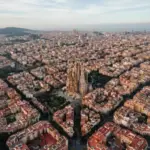

In the vibrant Poble-sec neighborhood of Barcelona, a remarkable project is taking shape on a seemingly overlooked sliver of public land. What might appear to be just another construction site is, in fact, a groundbreaking initiative: a ‘school-building’ designed to provide four social housing units for young people, while simultaneously serving as a hub for vocational training in sustainable construction. This is WikiHousing, an award-winning project that is redefining urban development and community engagement.
A Patchwork Plot, a Pioneering Vision
The site itself is unassuming – a small, corner plot that many might have dismissed as unbuildable. Yet, it is here that David Juárez, an architect from Straddle3 and the driving force behind WikiHousing, envisions a future where housing is not just about bricks and mortar, but about community, sustainability, and education. “This project has tested the limits of everything,” Juárez explains, “from the possibilities of a small plot yielding four 50-square-meter flats, to participation, training, materials, and finances. The result is a truly communal experience.”
WikiHousing, the winner of the 2021 BitHabitat urban innovation competition, is a collaborative effort. The land is provided by the Barcelona City Council, and the project is spearheaded by a consortium of architectural and housing cooperatives, including Straddle3, environmental consultancy Societat Orgànica, and the Idra institute. Their vision is to create a modular, wooden, and highly sustainable building that requires no heating or cooling, a testament to cutting-edge ecological design.
More Than Just Homes: A Training Ground for the Future
What truly sets WikiHousing apart is its ‘school-building’ concept. Over a hundred young people from diverse backgrounds have been actively involved in its design and construction through occupational training workshops. These participants, ranging from architects and anthropologists to an aircraft mechanic and a pharmacist, and even unaccompanied minors who have since regularized their status, are gaining certified qualifications from the College of Architects of Catalonia and the Impulsem social initiative educational center. This hands-on approach ensures that the project not only builds homes but also fosters skills and creates opportunities for a new generation.
The construction process itself is almost artisanal, emphasizing the value of traditional trades alongside modern techniques. Leading manufacturers of sustainable materials and solutions have contributed their expertise and products, creating what Juárez proudly calls “a club of excellence in the sustainable construction industry.” Companies like Technal, Tallfusta, Treehood, Aco, Riou, and HolaLuz have not just provided materials but have also offered training and shared their knowledge, demonstrating a deep commitment to the project’s educational mission.
Recycling, Innovation, and a Sense of Community
The commitment to sustainability extends to the materials used. The building incorporates various recycled components, from street tiles in the lobby to donated glass for interior partitions and high-quality panels from trade fairs repurposed for kitchen furniture. This innovative approach aligns perfectly with Barcelona’s status as the World Capital of Architecture this year, and the upcoming World Congress of Architects in the summer.
Sara Jansen, an illustrator and member of La Papiro, a collective of young architects and artists initially involved in channeling participation, has also joined the WikiHousing team. “I’m gaining the experience of building an alternative housing model, skills in energy, plot developability, modular construction, and material recycling,” she shares. The modular units, currently being assembled on site, were fabricated in workshops – three initial workshops built the four flats to scale, with three more planned on-site for finishes, solar panel installation (with HolaLuz providing training for women), and resident education on the building’s unique features.
The project has also attracted young architects from outside Spain, drawn by Catalonia’s reputation as a global leader in modular, timber, and sustainable construction. Giacomo Spanio, an Italian architect, describes the process as “a privilege, because as architects, we often stay on paper, and here we have gone through all scales, from paper to furniture, through structure, walls, and installations.” He believes it “demonstrates that architecture can once again be democratic, green, and built quickly, it can mark a path.” Marco Corvino celebrates how the project has brought “the role of the architect back to how it was understood in antiquity: to solve a need, a practice that has been lost and here has been communal and public.”
Efficiency by Design: A Model for the Future
Luca Volpi, an architect from Societat Orgànica, highlights the building’s exceptional energy efficiency, partly due to its “privileged south-facing corner location.” This orientation ensures maximum sun exposure in winter and natural shading from trees in summer. Volpi proudly states that the project “anticipates what European regulations demand: it utilizes consolidated urban land, has a very low ecological footprint, is replicable, uses sustainable timber in CLT (cross-laminated timber) panels, and is aligned with the circular economy, because the materials are natural and it is demountable.”
The agreement between WikiHousing as a developer and the Barcelona City Council was signed in late 2024. Through the Municipal Housing Institute, the council provides the plot at Avenida de la Exposició 38 for the four flats, which will be integrated into the city’s public housing stock. These units will be allocated through a lottery system to young people aged 18 to 35 registered as social housing applicants. In addition to the land, the City Council is funding half of the project’s cost (around 500,000 euros for the construction), a commitment that reflects its dedication to facilitating access to housing and exploring new avenues for collaboration to expand the public housing inventory.
WikiHousing is more than just a building; it’s a living laboratory, a community builder, and a beacon of sustainable innovation. It demonstrates that with creativity, collaboration, and a commitment to education, even the smallest urban spaces can be transformed into powerful engines of change, offering not just homes, but hope and opportunity for the next generation.
Source: https://elpais.com/espana/catalunya/2026-02-01/un-edificio-escuela-de-vivienda-publica-para-jovenes-en-barcelona.html