
The Battle of Barcelona: How the City Defied Franco’s Legacy 50 Years Ago
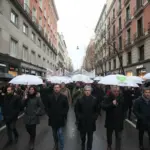
Fifty years ago this week, Barcelona became the epicenter of a pivotal moment in Spain’s transition from dictatorship to democracy. On February 1 and 8, 1976, just 43 days after the death of Francisco Franco, two massive demonstrations erupted, demanding amnesty and freedom. These events, later dubbed ‘The Battle of Barcelona’ by international media like the ‘Daily Mail’ and ‘The Guardian’, marked the Franco regime’s first significant defeat in the city since its troops entered on January 26, 1939.
This defeat was even more profound than the 1951 tram strike, which forced authorities to backtrack on fare increases and led to the civil governor’s resignation. The 1976 protests, though initially underestimated by the government, saw thousands overwhelm approximately 5,000 police officers. The second demonstration, held on February 8, was even larger, despite the brutal repression of the previous week. From today’s perspective, these protests undeniably altered the course of history.
The Context: A Regime in Denial
At the time, Carlos Arias Navarro remained Prime Minister, and Manuel Fraga, Minister of Information and Tourism, was still hailed by supporters with chants reminiscent of those for the recently deceased dictator. As historian Andreu Mayayo noted during the presentation of the exhibition ‘And after Franco, what?’, many people ‘complicated their lives by choosing not to’ during those critical days. The streets of Barcelona were filled with citizens making that choice.
Goya-esque Brutality and Photographic Evidence
The response from the police was nothing short of brutal, described as ‘Goya-esque’ by witnesses. Officers used their rifles as clubs, beating people of all ages, even those already on the ground. They smashed car windows, regardless of whether the vehicles were genuinely supporting the protesters. Pistols were drawn, as in the case of the notorious commissioner Genuino Navales, who fled a pursuing crowd with his weapon in hand.
Among the thousands of demonstrators were prominent journalists like Manuel Vázquez Montalbán, and dozens of photographers, some making their professional debut. Robert Ramos, for instance, borrowed his father’s camera without permission and has now, for the anniversary, retrieved his negatives. However, the name that stands out is Manel Armengol. Originally aspiring to be a writer, Armengol emerged from these protests as a renowned photojournalist, his work gaining immediate international recognition.
Armengol’s Daring Act and Global Impact
Armengol found himself at the right place at the right time, at the corner of Passeig de Sant Joan and Carrer de Provença. Hidden behind a tree, he captured the rhythm of the police batons with his camera, taking a roll and a half of film. One image shows an officer looking directly at him. He managed to escape, but his greatest feat was yet to come. Local press and agencies offered little for his photos and demanded his negatives, with no guarantee of publication. Seeing this, Armengol went to the airport and, in an astonishing move for the time, sought out passengers heading to major world cities. He gave them copies of his photos and a card with his name and instructions for the editors of ‘The New York Times’, ‘Newsweek’, ‘Der Spiegel’, ‘Stern’, ‘L’Express’, ‘Le Nouvel Observateur’, ‘Paris-Match’, ‘News Reporter’, ‘The Washington Post’, among others. It worked.
With Armengol’s photos as a powerful lead, ‘Newsweek’s’ international specialist wrote that Arias Navarro ‘still doesn’t believe Franco is dead; he keeps looking around for instructions from the caudillo and becomes paralyzed when he discovers he isn’t telling him what to do.’ In essence, Armengol’s photos flew abroad, created a resounding echo, and returned to Spain with deeper consequences than initially imagined.
The Assembly of Catalonia and Official Denial
While labor protests were frequent after Franco’s death, the February 1 and 8 demonstrations were an unprecedented challenge launched by the Assembly of Catalonia, using the then-legal facade of the Federation of Neighborhood Associations of Barcelona (FAVB) to request permits. Despite this, Civil Governor Salvador Sánchez-Terán denied authorization for both protests, a political decision that did not prevent him from later joining the electoral lists of the UCD party.
Forgotten History and a New Book’s Revelation
Half a century later, the memory of those two Sundays might seem confined to those who lived through them. The Transition was filled with so many political highs that these February events could appear as minor peaks. However, historians David Ballester and Manel Risques, in their exhaustive new book ‘Les manifestacions per l’amnistia i llibertat. Barcelona, 1 y 8 de febrer de 1976’, prove otherwise. The book acts as a time machine, immersing the reader in the battlefields of the Eixample streets, including Armengol’s Passeig de Sant Joan and Carrer d’Entença, where protesters attempted to free political prisoners, only to be met by armed officers emerging from La Modelo prison.
The Police Report: ‘There Was a Dance’
The chief of the National Police’s telephonic report to Civil Governor Sánchez-Terán on February 1 began with three words: ‘Ha habido baile’ (There was a dance). Neither suspected that a day starting at 8 degrees Celsius would end so heatedly. Riot police deployed all available equipment, including tear gas and the ‘botijo’ (the water cannon truck), and improvised tactics. ‘Tocineras’ (police vans) sped through the streets with open doors to knock down protesters. Radio communications from that day, cited in the book, reveal the intensity: ‘M20 to M30. Over. If we have to charge, charge with everything.’ And, ‘Be careful with that group. Over. H13 reports having dispersed about 600 approaching the prison on Carrer Provença. Our car is a mess. They threw many stones. We had to go after them. We had to fire four or five shots. Over.’
The book’s exemplary documentary and narrative immersion presents the protests from the perspective of the authorities, alongside dozens of testimonies from protesters who endured torture in Via Laietana and Enric Granados, or who, without such a nightmare, offer a panoramic view of those days.
Personal Stories of Resistance and Repression
Josep-Anton Monfort’s story is one of many referenced. A photograph taken by his father, part of the ‘Finestres de la memòria’ project, shows his bruised back after returning from the protests. Monfort, a PSUC militant, was doing military service in a ‘punishment battalion’ in Sabiñánigo, where his mail was opened, and he spent much of his service in solitary confinement. Yet, he used his February leave to attend the demonstrations. Fleeing a police charge, he took refuge in a doorway, only to be forced out through a gauntlet of officers who took pleasure in beating him.
Others suffered even more. Albert Lahuerta endured five days of mistreatment at the Via Laietana police headquarters, followed by further torment in La Modelo. His ordeal continued when he was forced to join the military in El Hierro, under a corporal who knew that 40 of his recruits had ‘political backgrounds.’ The barracks even had ‘volunteers’ from Cristo Rey whose mission was to make their lives miserable in that remote Canary Island.
A Legacy of Disappointment and a Point of No Return
Fifty years later, Monfort expresses disappointment that Francoism not only persists but still holds sway among some youth. The February protests ushered in a period of effervescence in the late 1970s, including the Catalan Women’s Days in May 1976 and the International Libertarian Days in Park Güell in July 1977. Monfort didn’t participate in the latter, not out of disillusionment, but because, as he admits, communist dogmatism prevented involvement in such an ‘orgy’ organized by anarchists. He leaves open the question of whether the February demonstrations were ultimately useful.
Risques, co-author of the book, firmly believes they were a turning point. Armengol with his photos, the protesters with their courage, and even the neighbors who cheered from balconies or honked car horns, pushed the authorities to an unexpected brink. A forgotten piece of evidence confirms this: in April 1977, Sánchez-Terán performed a final service as civil governor, under direct orders from Martín Villa. He oversaw the destruction of tens of thousands of documents archived in the Palau Montaner (now the Government Delegation), which named those involved in 40 years of repression and their victims. For four days, trucks carried documents to an abandoned factory in Poblenou, where a furnace burned paper for eight hours straight each day. This serves as a fitting, albeit dark, epilogue to those protests.
Source: elperiodico.com.cat