
The year 2026 finds us in a world marked by escalating violence and transactional geopolitics, where conflicts multiply and fester. In this stark reality, the ‘economy of security’ has emerged as a critical concept in geopolitical and geoeconomic analysis. This abrupt shift echoes Antonio Gramsci’s poignant observation: “The old world is dying, and the new world struggles to be born: now is the time of monsters.” The era of post-globalization, dramatically underscored by Russia’s aggression in Ukraine and the subsequent genocide in Gaza, has accelerated with Donald Trump’s return to power and the shifting foreign policy of the new U.S. administration. In this landscape, multilateralism and diplomacy appear to be losing ground to burgeoning fascisms, authoritarian populisms, and technofeudalisms.
The Rise of the Economy of Security: A Lucrative but Perilous Path
The normalization of coercion, the use of force, and warfare as instruments of foreign policy are relentlessly driving the economy of security and war into a strategic domain for both public and private action. Bruno Le Maire, France’s Minister of Economy, Finance, and Industrial and Digital Sovereignty from 2017 to 2024, was an early proponent of the term ‘economy of security,’ advocating for France and the European Union’s economic security and industrial sovereignty. Let us be clear: the economy of security is, above all, a lucrative business for a select few.
While we cannot naively assume that our democracies can abandon defense policies in the face of despots and dictators, it is another matter entirely to artificially boost the war industry with massive public funds, diverting essential resources from other economic and social policies that also impact human security. This raises a critical question: should the economy reorient itself towards security and defense policies, or is it possible to foster new conditions of security through an economy that prioritizes peace, cooperation, stability, and shared well-being?
Barcelona’s Vision: A Hub for the Economy of Peace
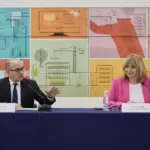
Recently, Barcelona hosted the Global Progressive Mobilisation, a significant gathering of heads of state and government, political leaders, and progressive activists from around the world who refuse to accept an illiberal and violent global order. Beyond the ethical and moral imperative to champion multilateralism, trade, cooperation, and solidarity, we have the responsibility-and the opportunity-to demonstrate the tangible benefits of the economy of peace as a powerful engine for societal progress.
Barcelona stands out as a global city that exemplifies and embodies the advantages of the economy of peace. It is an open, diverse, pluralistic, and inclusive city, the capital of Catalonia-a region renowned for its economic, industrial, and urban reputation, achieved without reliance on the military and defense industries. Barcelona and its successive mayors have played a leading role in crafting alternative narratives to conflict, advocating for city diplomacy as a human security policy founded on dialogue and cooperation. A testament to this commitment is Mayor Jaume Collboni’s initiative to establish the Barcelona International Peace Prize, reinforcing the city’s role as an international actor in promoting a culture of peace.
Urban Planning for Coexistence and Prosperity
Our city, celebrated for its modernist architecture, has developed urban planning strategies that serve coexistence and peace, recognizing them as fundamental to economic and social development. This economy of peace manifests in various sectors, including education, culture, sports, sustainability, and citizen participation. It is also evident in innovative urban projects like 22@, the promotion of Industry 4.0 at DFactory, and the commitment to the blue economy in partnership with the Port de Barcelona. The city has strategically leveraged education, sports, and culture as tools for economic competitiveness, creativity, and social cohesion. Its network of business schools, cultural centers, museums, festivals, and sporting events not only attracts tourism but also significant investments in cultural and sports industries, generating economic activity, employment, and opportunities. This blend of innovation, technology, sustainability, and civic values acts as a magnet, drawing major global events such as the Mobile World Congress, ISE, Seafood Expo, and Smart City World Congress, as well as the presence of over two hundred technology hubs from multinational corporations.
The economy of peace is more than just a narrative; it is a robust economic and urban model structured around strategic sectors like technological innovation, advanced industry, biotechnology, culture, sports, health, and sustainability. These sectors foster synergies and unequivocally demonstrate that investing in peace yields tangible economic, social, and cultural returns.
Barcelona: A Laboratory for a Transformative Economy
Ultimately, Barcelona has the opportunity to solidify its position as an urban laboratory for the economy of peace. Investing in an open, supportive, and inclusive world generates competitiveness, social cohesion, economic resilience, and international projection. We bear the responsibility to prove that peace is the ultimate catalyst for a transformative economy. As the recent global progressive gathering in the city highlighted, a significant portion of the world looks to Barcelona. We must not disappoint them.