
Barcelona Metro Station Congrés Officially Becomes Congrés-Indians
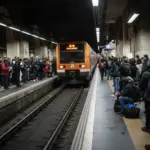
Barcelona, February 6, 2026 – The Congrés metro station on the L5 line has officially adopted the new name Congrés-Indians, a change that, although currently marked by a single sign, signifies a deep-rooted community demand and an ongoing adaptation of the city’s public transport network to its evolving identity. This transformation highlights how Barcelona’s metro stations serve not only as transit points but also as living reflections of the city’s history and its neighborhoods.
A Long-Awaited Change Reflecting Neighborhood Identity
The transition from Congrés to Congrés-Indians involves a long-standing claim for neighborhood identity. While only one sign has been updated so far, this symbolic gesture marks the beginning of a gradual process to reproduce the change across all signage, metro indicators, and hundreds of public transport network maps. This initiative, driven by local residents, underscores the importance of recognizing the distinct character of the Indians neighborhood.
Anna Badia López, reporting on February 6, 2026, emphasizes that this change on the L5 line adapts the metro map to the city’s reality. Barcelona’s stations, by indicating routes, also mirror the city’s transformation, reviewing its memory and acknowledging its neighborhoods, often in response to community demands.
The Evolution of Metro Station Names in Barcelona
The renaming of metro stations is not an uncommon occurrence in Barcelona. The change to Congrés-Indians was approved by the Autoritat del Transport Metropolità (ATM) in 2022, alongside 20 other railway stations within Barcelona and its surrounding areas. Another notable change approved at the same time was Vall d’Hebron to Vall d’Hebron-Sant Genís, also a result of persistent neighborhood advocacy. Other changes approved in 2022, such as Drassanes becoming La Rambla-Drassanes and Llucmajor becoming Llucmajor-República, are still awaiting materialization, following the renaming of the square a decade prior.
These changes are debated and approved by the ATM’s Naming Commission, which coordinates transport operators to standardize the public transport network’s nomenclature. Station name changes are typically motivated by three factors: unifying intermodal station names (e.g., Clot metro and Clot-Aragó Renfe, now El Clot), differentiating unlinked stations, and aligning network names with local realities. The latter, often driven by neighborhood demands, leads to changes like Vall d’Hebron and the recent, symbolic Congrés-Indians.
A Century of Adaptations: Over 50 Stations Renamed
The Barcelona metro network, with its hundred-year history, has seen numerous adaptations. Out of 165 stations, nearly 50 have had their original names modified, some more than once, particularly on historical lines. Approximately 20 stations on both L1 and L5, and about 15 on L3 and L4, have undergone renaming. Many of these renamings were prompted by the shift from Castilian to Catalan in nomenclature, as documented by Transports Metropolitans de Barcelona (TMB) for the metro’s centenary. Examples include Torres y Bages, Las Cortes, Rocafor, Plaza del Centro, Pueblo Seco (now Paral·lel, while the former Parlament stop is now Poble Sec), and Luchana (Llacuna), which was initially named Luchana.
Beyond linguistic considerations, other changes have been made. The bustling Sants Estació was initially Roma, named after the nearby avenue. Besòs-Mar adopted its current name in 1985, three years after opening as Mina. Aragón became Aragón-Gran Vía before transforming into Passeig de Gràcia in 1982, the same year Verdaguer shed its original Francoist name of General Mola. The network has also seen changes like Guinardó to Guinardó-Hospital de Sant Pau and Triunfo-Norte to Arc de Triomf. One of the stations with the most name changes is Ciutadella-Vila Olímpica. It opened in 1977 as Ribera, became Ciutadella with the L4 reorganization, and added the reference to Vila Olímpica in 1992.
The Historical Roots of Congrés-Indians
The station now known as Congrés-Indians was originally planned to be Garcilaso, after the street it occupies, but ultimately took the name of the neighborhood: Viviendas del Congreso, which was under construction at the time. The neighborhood’s history is as unique as the station’s. The housing complex was initiated by Gregorio Modrego, then bishop of the city, taking its name from the International Eucharistic Congress held in Barcelona in 1952. The station began service in 1959 on L2 and transferred to L5 with its extension between Diagonal and La Sagrera. The second name change occurred with its Catalanization in 1982, and the third, to Congrés-Indians, is now being materialized.
While Congrés stems from the International Eucharistic Congress, the ‘Indians’ part of the name has its own distinct origin. The neighborhood has included ‘Indians’ in its name for 20 years, representing a unique area with a very different character from the Congrés blocks. The area became known as ‘dels Indians’ following another historical event: the Cuban War and the return of Barcelonans who had made their fortunes in the Americas. Some chose these then-undeveloped lands of Sant Andreu del Palomar to build residences reflecting their wealth, creating a landscape of towers and houses like Torre Rosa, built in 1920 and now a cocktail bar. The streets of the neighborhood clearly reflect this Caribbean heritage, with names like Manigua, Puerto Príncipe, Matanzas, and Cienfuegos. These names serve as historical witnesses to a moment in the city’s reality.
Between Manigua and Garcilaso street, where the metro is accessed, a now-disappeared vacant lot was the site of another historical episode with global impact: it hosted the first field of FC Barcelona at the beginning of the century, long before the metro, Congrés, or Indians existed. By incorporating the neighborhood’s origin and history, and responding to community demands, the station’s new name, with its hyphen and seven letters, now represents a more complete neighborhood identity, even if symbolically.