
Barcelona Reactivates Low Emission Zone Amidst Rodalies Network Disruptions
Barcelona, Catalonia, Spain – March 17, 2026 – Barcelona has reinstated its Low Emission Zone (ZBE) restrictions today, Monday, March 17, 2026, following a nearly two-month suspension. The measure was reactivated after a decree signed by Mayor Jaume Collboni, based on communication from the Generalitat that the exceptional circumstances justifying the suspension had disappeared.
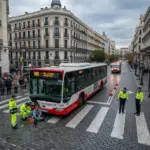
The ZBE had been deactivated since January 22, when severe incidents on the Rodalies rail network necessitated a temporary easing of traffic restrictions to facilitate citizen mobility. During this period, difficulties in the railway service, including interruptions and reduced frequencies, led authorities to permit greater use of private vehicles.
Generalitat Cites “Significant” Public Transport Recovery
According to the Generalitat’s communication, the public transport situation has “significantly” recovered in recent weeks, with reinforced bus connections between municipalities. This scenario has allowed for the re-establishment of the ZBE’s normal operation.
However, it is important to note that, also as of this Monday, improvement works are underway on the R2 sur line, leading to reduced train frequencies and requiring a road reinforcement plan. The R4 line has not yet returned to normal, with the section between Martorell and Sant Sadurní d’Anoia remaining closed. Furthermore, the R3 line has only partially recovered its train services between La Garriga and Ripoll.
Nevertheless, the Generalitat has reactivated the measure. Consequently, older and more polluting vehicles, those without an environmental label from the Directorate-General for Traffic, are once again prohibited from circulating within the restricted zone’s perimeter. Barcelona’s Low Emission Zone covers almost the entire city, with the exception of the Vallvidrera, Tibidabo, and Les Planes neighborhoods, as well as the Zona Franca industrial estate. The restriction is part of the municipal strategy to reduce polluting emissions and improve air quality in the metropolitan area.
Political Debate Rekindled by ZBE Reactivation
The reactivation of the ZBE has reignited political debate regarding its operation. Daniel Sirera, president of the Popular Party of Catalonia’s municipal group in the Barcelona City Council, has proposed modifying the current system to allow any vehicle that passes emissions tests during technical inspection to circulate.
Sirera suggests replacing the current model, based on environmental labels, with one focused on the real emissions registered by vehicles during the Technical Vehicle Inspection (ITV). According to Sirera, the current system creates situations that are difficult for many drivers to understand, as some cars may pass ITV emissions controls but remain prohibited from accessing the city due to their manufacturing year.
The city’s decision to reactivate the ZBE while parts of the Rodalies network remain affected raises questions about the balance between environmental objectives and the practical needs of commuters. The ongoing disruptions on the R2 sur, R4, and R3 lines continue to impact daily travel for thousands of residents, who may now face additional challenges in their commutes due to the reinstated ZBE restrictions.
Impact on Commuters and City Traffic
The immediate impact of the ZBE reactivation will be felt by drivers of older vehicles who rely on them for their daily commutes, especially those affected by the Rodalies disruptions. The restrictions aim to improve air quality, but their implementation coincides with a period of reduced public transport reliability for certain routes. This could lead to increased congestion on alternative routes and a greater burden on the reinforced bus services.
The city’s long-term strategy for air quality improvement is clear, but the timing of this reactivation has drawn criticism from political opposition and raises concerns among residents who depend on a fully functional public transport network. The debate over the most equitable and effective way to manage urban emissions is expected to continue as Barcelona navigates these challenges.
Source: eldebate.com