
Barcelona’s Urban Seating: A Costly Conundrum Amidst Shifting Priorities
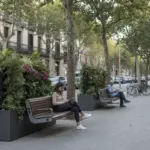
Barcelona’s commitment to enhancing its public spaces is evident in its recent investment in urban seating. Between 2023 and 2025, the city acquired and installed 8,613 benches, chairs, and tables across its streets, promenades, and squares. While the sheer volume of new additions might suggest a proactive approach to urban comfort, a closer look reveals a complex and often contentious landscape, marked by significant costs, resident complaints, and a growing debate over the very philosophy guiding the city’s urban design.
The financial outlay for this urban furniture is substantial. Each bench, on average, costs a staggering 1,419.01 euros to acquire and install, while individual chairs come in at half the price, 774.43 euros. The largest procurement occurred in 2024, with 3,058 new pieces, followed by 2,954 in 2023, and a slightly reduced figure of 2,601 in 2025. These figures, provided by the city council, underscore a significant expenditure that warrants scrutiny, especially when juxtaposed with the ongoing complaints from various community groups.
The Disconnect Between Investment and Resident Needs
Despite the considerable investment, a common demand for increased seating from a unified entity is absent. Instead, the issues manifest at a granular level, often on a street-by-street or neighborhood-by-neighborhood basis, reflecting a particular and subjective impression of insufficiency. Residents of Sagrada Família, for instance, lament the absence of benches on vertical and sloping streets. The Can Baró platform echoes this, noting that narrow sidewalks in their ‘mountain neighborhood’ make placement difficult, even as existing benches in squares are constantly occupied, a critical issue for an aging population.
Conversely, some areas like Movimiento Diagonal Mar report no issues, with existing benches being repaired and no complaints. The Maresme Neighborhood Association, while satisfied with recent bench replacements, highlights a need for more waste bins. These varied responses paint a picture of uneven distribution and a lack of a cohesive strategy that addresses the diverse needs of Barcelona’s residents.
The Scarcity in Ciutat Vella and Gràcia: A Tale of Terraces and Tourism
Ana Menéndez, Vice President of the Federation of Neighborhood Associations of Barcelona (FAVB), points to a recurring problem: a scarcity of benches in areas saturated with terraces, such as Calle Blai, Enric Granados, Plaza Reial, and many small squares in Ciutat Vella. This observation suggests a tension between commercial interests and public amenity, where the expansion of outdoor dining areas often comes at the expense of public seating.
Gràcia, in particular, stands out with the lowest number of seats in the city. Àngel Urraca, a 61-year-old resident with reduced mobility, expresses profound frustration. He notes that while some benches were added after the renovation of Pi i Margall, and there are some on Paseo de Sant Joan, the old town remains severely lacking. ”When I go with my wife and I see a bench, I sit down, but sometimes I can’t stop because, if there are any, they are always full,” he recounts, highlighting the daily struggle faced by many. He attributes this scarcity to the occupation of public space by terraces, leaving little room for essential public infrastructure.
The Rise of Hostile Architecture: A Divisive Trend
A more insidious trend identified by residents and urban experts is the proliferation of individual chairs over traditional benches. The Arrels Foundation, which supports homeless individuals, identifies these as examples of the 1,200 elements of ‘hostile architecture’ in Barcelona, disproportionately affecting those living on the streets.
Mirela Fiori, director of the Master’s in City and Urbanism at the Open University of Catalonia, views the replacement of long benches with fixed, individual chairs as ”a very hostile policy.” She describes it as ”defensive or preventive urbanism” that aims to deter undesirable behaviors like littering or sleeping, but ultimately ostracizes not only the intended targets but also vulnerable groups like the elderly. While Anna Maria Puig, a researcher on sustainable cities, argues that individual seats can still serve the function of rest, she emphasizes the importance of context and comfort for social interaction.
Ricard Ferrer, director of the Master’s in Furniture Design at Elisava, acknowledges the debate surrounding these ‘dissuasive’ models, calling it a ”delicate issue” without easy solutions. However, he suggests that a rethinking of bench design could be a way forward, implying that current approaches may be missing the mark.
The Problem of Removal: When Public Space Becomes Contested
Adding to the complexity, Barcelona has even removed seating in certain areas, citing complaints about coexistence issues, as seen last summer in the Sant Antoni superblock. Màrius Navazo, a public space specialist, argues that bench removal should only occur in cases of significant harm or persistent problems, not merely based on discomfort. He advocates for alternative solutions like reorienting benches or adjusting lighting before resorting to such a drastic measure. Fiori strongly agrees, stating that ”removing benches is not the solution, nor is putting isolated fixed chairs, and cold concrete benches without backrests end up driving everyone away, not just those they want to drive away.”
A Call for Strategic Urban Planning
Barcelona’s approach to urban seating highlights a critical need for more strategic and inclusive urban planning. The current situation, characterized by high costs, uneven distribution, a rise in hostile architecture, and the removal of existing seating, suggests a city grappling with its identity. Is it a city for tourists, for businesses, or for its residents, particularly its most vulnerable? The answer lies in a re-evaluation of priorities, moving beyond reactive measures to a more holistic vision that prioritizes comfort, accessibility, and social cohesion in its public spaces.
Source: elperiodico.com.cat